 Saas
Best help desk software for small support teams
Our top pick for a small support team is Help Scout. It takes this fight card with a 32 on our four fixed rounds. Its free plan seats five users with a shared inbox and a knowledge base at no cost, Standard is $25 per user per month on the annual toggle, and AI is metered at $0.75 per resolved conversation instead of rented by the seat. Freshdesk is the pick when the per-agent price decides, at $19 for a complete ticketing system with a customer portal and 500 AI agent sessions. Zendesk is the pick only when your customers phone you, because it is the single product here with native voice, and that capability starts at $55 per agent per month. All three cards were built from the vendors' own pricing pages, FAQs and developer documentation plus their public Trustpilot profiles, read on October 13, 2026.
Our picks
- Best for teams under 25 whose queue is text: Help Scout
- Best for the lowest price on a full ticketing system: Freshdesk
- Best for queues with a phone channel: Zendesk
The fight card at a glance
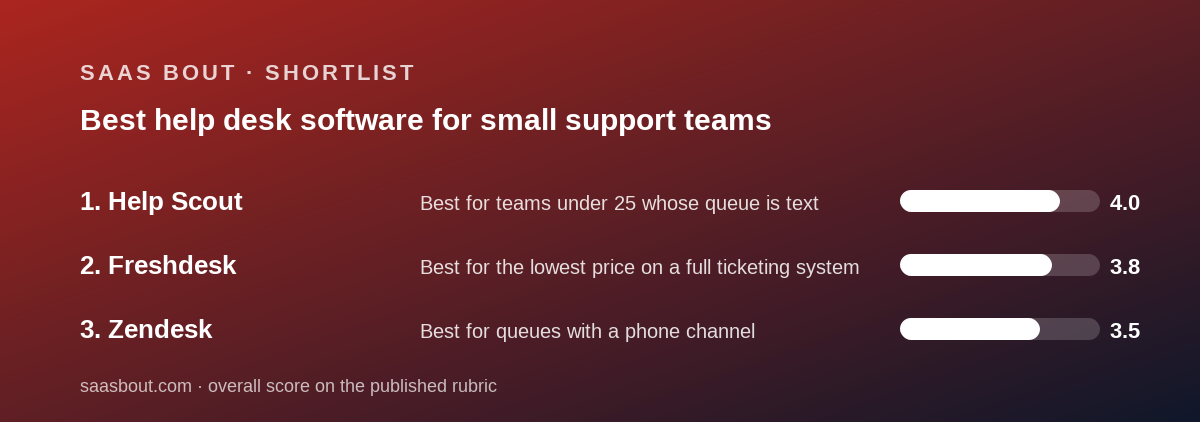
Three fighters, four rounds, one card. The totals: Help Scout 32, Freshdesk 30, Zendesk 28. Four points separate first from last, so the division is close and the right pick depends on channel mix, team size and who will own the configuration.
1. Help Scout, best for teams under 25 whose queue is text. Ease 9, features 7, value 8, support 8. Free for 5 users; Standard $25, Plus $45, Pro $75 per user per month on the annual toggle.
AI Answers $0.75 per resolution. 15-day trial, no card.
2. Freshdesk, best for the lowest price on a complete ticketing system. Ease 8, features 8, value 8, support 6. Growth $19, Pro $55, Enterprise $89 per agent per month billed annually.
No free plan. 500 AI agent sessions included once per account. 14-day trial on Enterprise.
3. Zendesk, best for queues with a phone channel. Ease 6, features 9, value 6, support 7. Support Team $19 for email ticketing only; Suite Team $55, Suite Professional $115 per agent per month paid yearly; top tier by quote. Copilot add-on $50.
No free plan.
Freshdesk and Zendesk tie at $19 on the headline and nowhere else. The bout most buyers actually face is scored round by round in Zendesk vs Freshdesk.
How we grade
The four rounds are set before the bout and never change. Scores are out of 10 on a must system, so a round is always won by somebody and a tie has to be argued for.
The round that moves these cards most is ease, and in this division ease is mostly about the pricing page. A help desk is bought by an operations lead with no procurement team behind them.
If a vendor hides the cap, the lead finds it in production.
The full method is in the How we chose note above. One line is worth repeating: no figure appears on a card unless it was read on a primary source, with the date recorded.
Best for teams under 25: Help Scout
Why it sits at number one: it wins the ease round 9 to 8 and never drops below 7, and it is the only fighter here a team can run for free while deciding.
The bill. Five users cost $0 on Free or $125 a month on Standard. Ten cost $250 on Standard or $450 on Plus. Twenty-five cost $625 on Standard, the plan ceiling, all editorial calculations from the annual rates.
What it does not do is the phone. Voice and SMS are listed as integration-only on all three paid plans, with preferred Aircall pricing on Pro. SSO, HIPAA and IP restrictions are add-ons below Pro, and Pro carries a 10-seat minimum.
Full round-by-round scoring, including the light-user discrepancy between the plan card and the comparison table, is in the Help Scout review.
Best for the lowest price on a full ticketing system: Freshdesk
Why it sits at number two: it matches Help Scout on value and beats it on features, then loses the support round 8 to 6 for publishing no SLA, no support hours and no response-time target anywhere on its pricing page.
The bill. Five agents cost $95 a month on Growth or $275 on Pro. Ten cost $190 or $550. Twenty-five cost $475 or $1,375, all editorial calculations from the published per-agent rates.
The feature ladder is the clearest in the division. Round robin and load balancing arrive on Pro, skill-based assignment on Enterprise, and the knowledge side carries article versioning, approval workflows, community forums and up to five nested folders per category.
The risk is the exit, not the entry. There is no free plan, the 14-day trial runs on Enterprise rather than on the plan most teams buy, and cancellation only takes effect at the end of the term.
Scoring in the Freshdesk review.
Best for queues with a phone channel: Zendesk
Why it sits at number three: it wins features 9 to 8 and loses ease and value by two points each, because so much of the advertised product is priced outside the plan.
The bill. Five agents cost $95 a month on Support Team, which is email ticketing only, or $275 on Suite Team. Ten cost $190 or $550. Twenty-five cost $475 or $1,375, with Suite Professional at $2,875, all editorial calculations.
Then add the sheet. Copilot is $50 per agent per month, the Workforce Engagement Bundle $50 and Contact Center $83, all paid yearly. Copilot usage is pooled at 5 uses per agent per month with a hard cap of 500 uses per instance per month.
What justifies the price is capability nobody else here sells. Native voice with IVR, recording, monitoring and barging. Four data residency regions. API rate limits, event volumes and retention windows published per tier. A marketplace at 1,800+ apps.
The caveat is sizing. This is a platform for roughly 20 agents and up with an admin who owns it, and the $19 plan is not a cheap way in. Scoring in the Zendesk review and the bout Zendesk vs Freshdesk.
Also compared: two products that could not be ranked and two that were
Intercom and HubSpot Service Hub both read cleanly from their pricing pages on October 13, 2026 and both were left off the card for the same reason: neither is primarily a help desk for a small support team at the prices published.
Intercom lists Essential at $29 per seat per month, Advanced at $85 and Expert at $132, with a 1 full seat minimum, a 14-day trial and no free plan. Fin, its AI agent, is sold standalone at $0.99 per outcome with no seats required.
That is a defensible shape for a product-led company that wants in-app messaging, and it is an expensive shape for a five-person email queue. Advanced includes 20 free Lite seats and Expert 50, which tells you who the plans are drawn for.
HubSpot Service Hub prints a free plan for up to 2 users, then Starter at $7 or $20 per seat per month depending on the billing toggle, Professional at $90 or $100, and Enterprise at $150.
Those figures came from a headless-browser read of the page, because a plain fetch returned the page without its pricing section.
The number that disqualifies it for a small team is not the seat price. Professional carries a required one-time onboarding fee of $1,500 and Enterprise a required $3,500, both printed as footnotes on the pricing page.
A five-person team buying Professional pays the onboarding fee before the first ticket.
Two sources were also excluded rather than two products. G2 and Capterra both returned HTTP 403 to a fetch and to a headless browser on October 13, 2026, so no G2 or Capterra scores appear anywhere on these cards.
Where a vendor cites a G2 award on its own site, we say that the claim is printed and that we could not open the report.
How to choose help desk software for a small team
Start with the channel list, not the price. Email, portal and chat are available on all three products. A phone channel is available on one. If customers call you, the shortlist is one item long and the budget has to meet it.
Then count the seats you will actually buy, including the people who touch tickets twice a week. Freshdesk day passes cost $2 to $12 a day. Help Scout includes 5 light users on Plus and 15 on Pro.
Zendesk prints a dash for light agents on its $19 plan.
Then price the AI line separately from the plan, because all three vendors meter it and none of them meters it in the same unit. Help Scout charges per resolved conversation, Zendesk per automated resolution, Freshdesk per 72-hour session.
Model your own thread lengths before quoting a saving.
Then read the exit before the entry. Freshdesk states no cancellation fee but makes cancellation effective at end of term. Zendesk publishes no refund policy.
Help Scout publishes none either, but its free plan means a team can leave a paid tier without leaving the product.
Finally, treat the review sites as a map of complaint types rather than a verdict.
All three Trustpilot profiles are poor, and the themes differ in a way that is more useful than the stars: Zendesk reviewers complain about complexity, Freshdesk reviewers about billing, Help Scout reviewers about onboarding and price changes.
What a help desk is not
Two shortlists get confused with this one often enough to be worth naming. The first is CRM. Teams that want to see who owes a reply sometimes actually want to see who owes a decision, which is a pipeline problem.
Our CRM division scores HubSpot CRM, Pipedrive and Zoho CRM on these same four rounds, and the ranking is in the CRM fight card for small sales teams.
The two bouts that settle most of it are HubSpot CRM vs Pipedrive and Pipedrive vs Zoho CRM.
The second is project management. If the real failure is internal handoffs rather than customer messages, a ticket queue will not fix it. Start with our Asana review instead.
What changed since this card was built
Nothing yet: this is the first help desk fight card and every figure on it was read on October 13, 2026.
Pricing pages in this category move several times a year, so each revision will be logged here with the date and the number that changed.
Two figures to watch in particular. Zendesk and its developer documentation currently describe different plan ladders, and the Freshdesk pricing page and product page currently print different customer counts. Both are vendor inconsistencies rather than reading errors, and both should resolve on their own.
Bottom line
Buy Help Scout if your team is 25 or fewer and your customers write rather than call.
Start on the free plan at five users, move to Standard at $25 per user when you outgrow one inbox, and meter AI at $0.75 a resolution with a cap set.
Buy Freshdesk Growth at $19 per agent per month billed annually if the per-seat price is the deciding number and you want a customer portal, a knowledge base and SSO on the cheapest plan in the division.
Buy Zendesk Suite Team at $55 per agent per month paid yearly if the phone is a channel, if a compliance review will ask which region holds the data, or if you build against the API and need published rate limits.
Do not buy Zendesk Support Team at $19 expecting a help desk. Zendesk's own comparison table prints a dash against messaging, live chat, the help centre and voice for that plan, and that single misreading is the most expensive mistake available in this category.
Prices, caps and plan names change. Every figure on this card was read on a vendor page, a vendor FAQ, vendor developer documentation or a public Trustpilot profile on October 13, 2026. Check the page before you sign.
Best for teams under 25 whose queue is text: Help Scout
Help Scout takes the card with a 32: ease 9, features 7, value 8, support 8. The free plan seats 5 users with 1 inbox, 1 Docs site and 100 contacts a month, which no rival here matches at any price.
Standard at $25 per user per month on the annual toggle adds live chat, WhatsApp, Instagram, Messenger, a knowledge base, 150 workflows and 200 API calls a minute.
The pricing page prints a number against almost every limit a small team will hit, from inboxes and Docs sites to light users and reporting history.
AI Answers is metered at $0.75 per resolved conversation with a spending cap the buyer sets, and three months of unlimited resolutions are free from account creation. The honest limit is voice: phone is listed as integration-only on every plan, including Pro.
Wins the ease round outright and never scores below 7; the only free plan here that seats a whole small team.
Visit Help Scout
We have no affiliate relationship with this vendor. Link goes to the official site.
Best for the lowest price on a full ticketing system: Freshdesk
Freshdesk scores 30: ease 8, features 8, value 8, support 6.
Growth at $19 per agent per month billed annually is a complete help desk rather than a teaser, with ticketing, a shared inbox, a customer portal, a knowledge base, analytics, roles and permissions, single sign-on and 500 Freddy AI Agent sessions.
Pro at $55 adds a multilingual helpdesk, intelligent routing, multiple SLA policies, 5,000 collaborators and load-balanced assignment. Enterprise at $89 adds skill-based routing, a sandbox, audit logs and IP allowlisting.
Every add-on carries a printed price, including the only per-day rate in this division: day passes at $2, $7 or $12 per agent per day. Two things cost it the top spot.
There is no free plan, and the support round is the weakest card here, with no published SLA and a Trustpilot profile at 1.5 out of 5 from 412 reviews.
Ties Help Scout on value and beats it on features, but loses the support round 8 to 6 and has no free plan to test on.
Visit Freshdesk
We have no affiliate relationship with this vendor. Link goes to the official site.
Best for queues with a phone channel: Zendesk
Zendesk scores 28 and wins the features round outright: ease 6, features 9, value 6, support 7. Nothing else here publishes a table this deep.
Native voice with IVR, call recording, monitoring and barging, numbers in 75+ countries and a 99.95 percent voice uptime SLA with usage credit. A data centre location add-on covering the US, APAC, the European Economic Area and the United Kingdom.
API rate limits, custom object caps, monthly event volumes and retention windows published per tier. A marketplace listed at 1,800+ apps. The price of that depth is the card's lowest ease and value scores.
Support Team at $19 is email ticketing only, with a dash printed against messaging, live chat, help centre and voice. Suite Team at $55 is the real entry, and Copilot, the AI advertised across the page, is a $50 per agent add-on below Enterprise.
Wins features 9 to 8 but loses ease and value by two points each; the depth only repays teams of roughly 20 agents and up.
Visit Zendesk
We have no affiliate relationship with this vendor. Link goes to the official site.
How we chose
We did not run paid trials or staged demos. Grades come from documentation, pricing pages, developer documentation and verified user reports checked on October 13, 2026. Each fighter is scored on four fixed rounds on a 10-point must system, for a card out of 40.
Ease: how fast a small team without a dedicated admin gets productive, judged from the product model, the free path, and above all from whether the pricing page prints a number against the limits a buyer will meet.
Features: what the vendor documents per plan, weighted toward the plan a small team actually buys, with published caps counted over marketing claims.
Value: total cost for a realistic team at 5, 10 and 25 seats on the plan it would buy, including the AI line and the add-on sheet, not just the headline rate.
Support: what the vendor commits to in writing, per plan, plus what verified users report. A vendor that publishes an uptime SLA with a credit attached scores above one that publishes nothing, regardless of marketing language.
Products are excluded when their pricing page cannot be read from a primary source. Two were excluded and are listed in the section below.
Frequently asked
What is the best free help desk software for a small team?
Help Scout, on the three products scored here. Its free plan covers 5 users, 1 inbox, 1 Docs site, 100 contacts a month and 30 days of reporting history, per the pricing page read October 13, 2026. Neither Freshdesk nor Zendesk publishes a free plan at all.
How much does help desk software cost for a 10-person support team?
Between $190 and $1,150 a month on these three products, all editorial calculations from published per-seat rates read October 13, 2026. Freshdesk Growth is $190, Help Scout Standard $250, Help Scout Plus $450, Freshdesk Pro and Zendesk Suite Team $550 each, Zendesk Suite Professional $1,150.
Which help desk software includes phone support?
Only Zendesk, of the three ranked here. It lists native voice with IVR, call recording, monitoring, barging, callbacks and numbers in 75+ countries, starting on Suite Team at $55 per agent per month paid yearly. Help Scout lists phone via integration; the Freshdesk pricing page lists no voice channel.
Is Zendesk worth it for a five-person team?
Rarely, on the evidence here. The cheapest multichannel Zendesk plan is $275 a month for five agents against $95 for Freshdesk Growth, editorial calculations. The depth that wins Zendesk the features round, voice and data residency and published API limits, is mostly unused at that size.
How do these vendors charge for AI?
In three different units. Help Scout charges $0.75 per resolved conversation with a cap you set. Zendesk charges $1.50 or $2.00 per automated resolution beyond the plan allowance. Freshdesk includes 500 sessions once per account, where an email session is a 72-hour window, then $49 per 100.
Why are Intercom and HubSpot Service Hub not ranked here?
Both pricing pages read cleanly on October 13, 2026 and both products are drawn for different buyers. Intercom starts at $29 per seat with Lite seats bundled for product-led teams. HubSpot Service Hub Professional at $90 per seat carries a required one-time onboarding fee of $1,500.
Do any of these publish an uptime guarantee?
Only Zendesk, and only on voice: a 99.95 percent uptime SLA with usage credit in the event of provider outages. Help Scout's site footer prints a 99.99 percent status figure with no credit attached. The Freshdesk pricing page publishes no uptime figure at all.
Update history
- October 13, 2026 - First fight card for the help desk division. Three fighters scored from vendor pricing pages, FAQs, Zendesk developer documentation and Trustpilot, read October 13, 2026. Intercom and HubSpot Service Hub read successfully but excluded from the ranking as a different buyer shape; HubSpot figures required a headless-browser DOM read because a plain fetch returned the page without its pricing section. G2 and Capterra returned HTTP 403 to both methods, so no scores from either appear on this card.