 Saas

Zendesk
The deepest feature table in the help desk division, with native voice, data residency choices and published API limits, sold through a four-tier ladder and an add-on sheet that most small teams misread
Scored on the published rubric, from documentation, pricing and verified user reports.
Best for: Support organisations of 20 or more that need native voice, a choice of data centre region, published API rate limits and a 1,800-app marketplace, and have someone whose job is to own the configuration.
Verdict
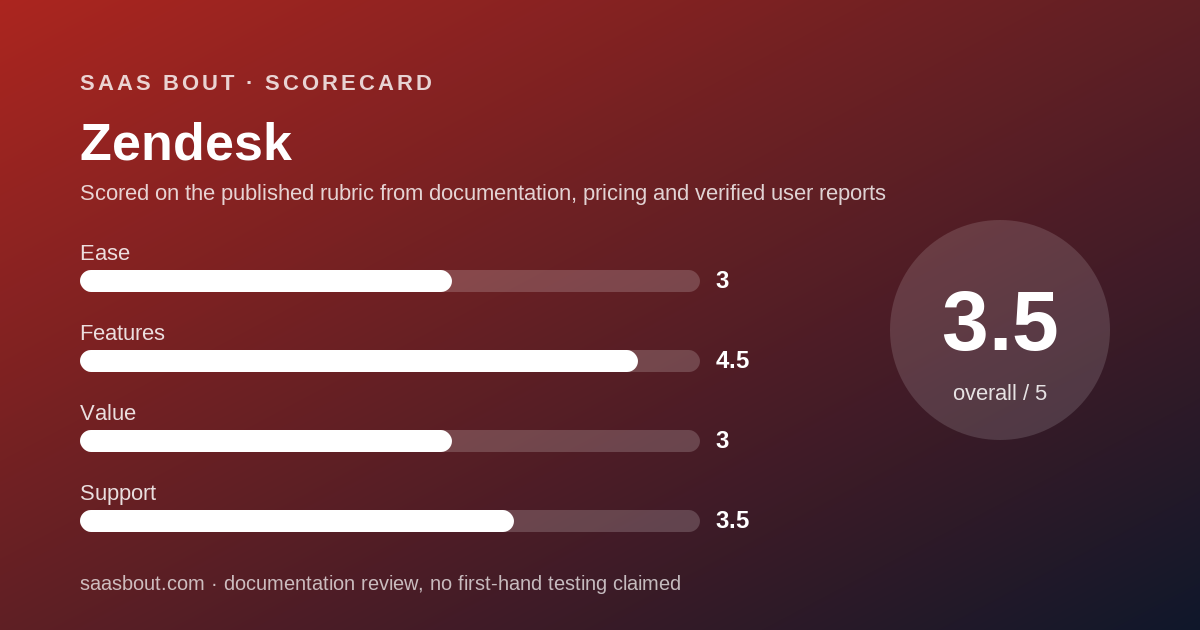
Zendesk scores 28 on our four-round card: ease 6, features 9, value 6, support 7. It places third in the help desk division behind Help Scout on 32 and Freshdesk on 30, and it wins the features round outright. This is a documentation review. Every figure comes from the Zendesk pricing page, the developer usage-limits documentation, two Zendesk help centre articles and the public Trustpilot profile, all read on October 13, 2026, and not from paid trials or staged demos. Features scores 9 because no rival here publishes a table this deep: native voice with IVR and call recording, a data centre location add-on covering the US, APAC, the European Economic Area and the United Kingdom, API rate limits per plan, event volumes per plan and 1,800 marketplace apps. Ease scores 6, the lowest in the division, because the buyer must first choose between a Support plan and a Suite plan, then read a column where the $19 plan shows a dash against messaging, live chat, help centre and voice. Value scores 6 because the cheapest plan that behaves like a modern help desk is $55. Support scores 7. Buy it if voice and residency are requirements. Skip it if nobody owns the configuration.
Visit Zendesk
We have no affiliate relationship with this vendor. Link goes to the official site.
Where it is strong
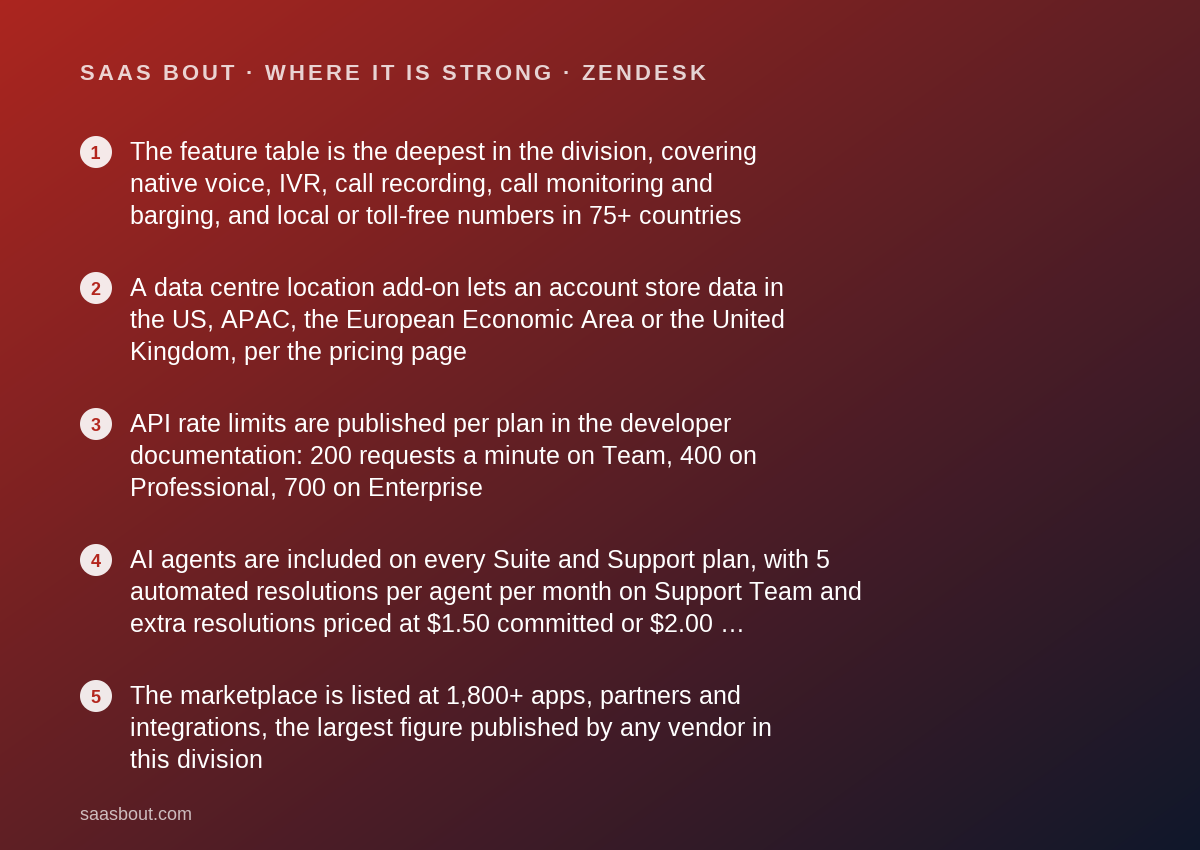
- The feature table is the deepest in the division, covering native voice, IVR, call recording, call monitoring and barging, and local or toll-free numbers in 75+ countries
- A data centre location add-on lets an account store data in the US, APAC, the European Economic Area or the United Kingdom, per the pricing page
- API rate limits are published per plan in the developer documentation: 200 requests a minute on Team, 400 on Professional, 700 on Enterprise
- AI agents are included on every Suite and Support plan, with 5 automated resolutions per agent per month on Support Team and extra resolutions priced at $1.50 committed or $2.00 pay-as-you-go
- The marketplace is listed at 1,800+ apps, partners and integrations, the largest figure published by any vendor in this division
- Qualified startups are offered a 6-month trial of the Zendesk Suite for up to 50 agents
- Voice carries a 99.95 percent uptime SLA with usage credit, the only uptime commitment published in this division
Where it falls short
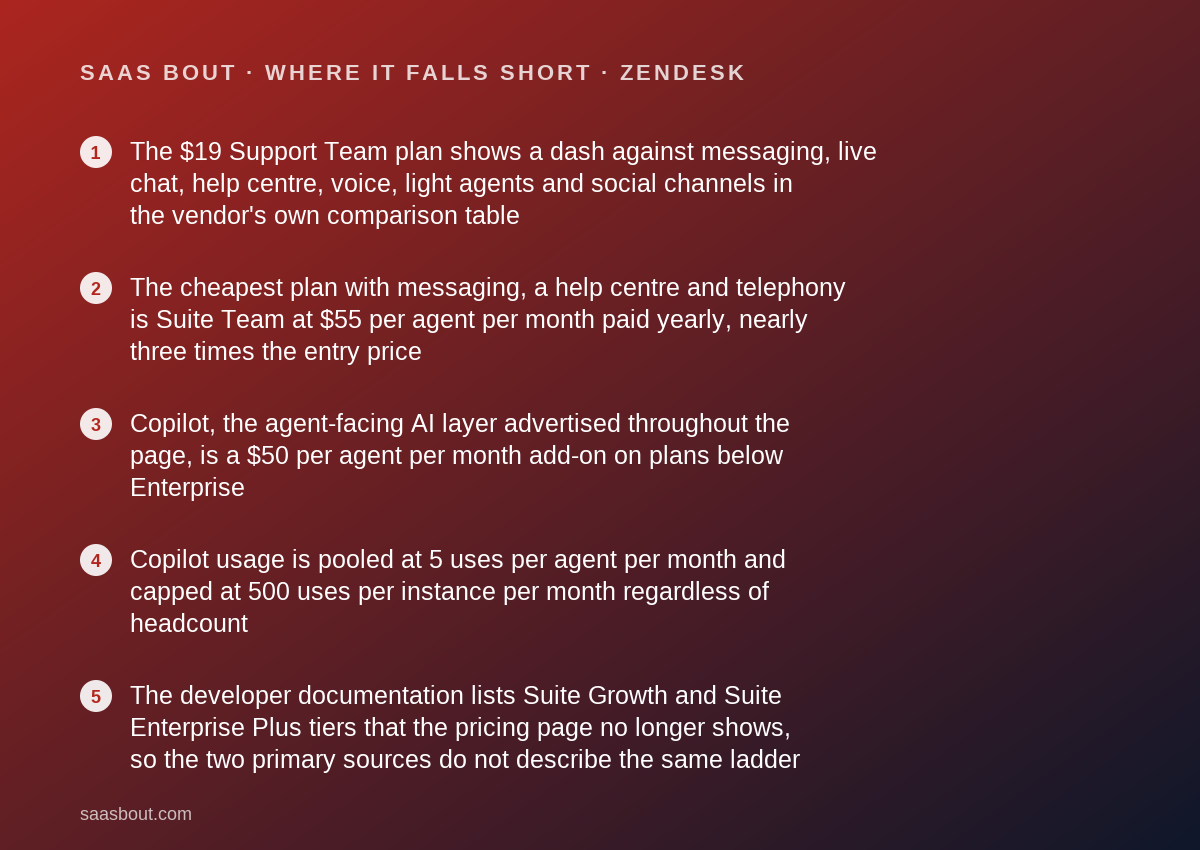
- The $19 Support Team plan shows a dash against messaging, live chat, help centre, voice, light agents and social channels in the vendor's own comparison table
- The cheapest plan with messaging, a help centre and telephony is Suite Team at $55 per agent per month paid yearly, nearly three times the entry price
- Copilot, the agent-facing AI layer advertised throughout the page, is a $50 per agent per month add-on on plans below Enterprise
- Copilot usage is pooled at 5 uses per agent per month and capped at 500 uses per instance per month regardless of headcount
- The developer documentation lists Suite Growth and Suite Enterprise Plus tiers that the pricing page no longer shows, so the two primary sources do not describe the same ladder
- Monthly per-agent prices are printed only for Support Team ($25); the Suite monthly figures render after clicking the toggle and could not be read
- Trustpilot showed 1.8 out of 5 from 738 reviews with 80 percent one star, the worst standing in this division
- No free plan is offered at any tier
At a glance
| Starting price | $19/agent/mo paid yearly (Support Team); $25 monthly |
|---|---|
| Pricing note | From $19 per agent per month paid yearly for email ticketing only, or $55 for the cheapest multichannel Suite plan (pricing page, checked October 13, 2026) |
| Cheapest Suite plan | Suite Team $55/agent/mo paid yearly; Suite Professional $115; Suite Enterprise + Copilot by quote |
| Free plan | None offered |
| Seat minimum | Not stated on the pricing page or in the Support plan types article |
| Trial | 14 days on the Customer Service Suite Professional plan, with Copilot included by default |
| AI pricing | 5 automated resolutions per agent per month on Support Team, up to 10k a year included; extra at $1.50 committed or $2.00 pay-as-you-go |
| Add-ons | Copilot $50/agent/mo; Workforce Engagement Bundle $50; Contact Center $83, all paid yearly |
| API | 200 requests/minute on Team, 400 on Professional, 700 on Enterprise, 2,500 on Enterprise Plus or the High Volume API add-on |
| Data residency | US, APAC, European Economic Area or United Kingdom via the Data Center Location add-on |
| Currencies | USD, EUR, GBP and BRL, per the pricing FAQ |
What Zendesk actually is
Zendesk is two product families sold from one pricing page. Support is email ticketing. Suite is the same ticketing plus messaging, live chat, a help centre and telephony, and it is what most people mean when they say Zendesk.
On top of both sits a layer the page calls the Resolution Platform: AI agents that handle customer requests, Copilot that helps the human agent, action and app builders, quality assurance and workforce management.
Almost every part of that top layer is priced separately, by seat or by usage. The plan price is a floor, not a total.
That structure is why the card reads the way it does: features 9, the best in the division, against ease 6 and value 6, the worst in the division.
It is not a CRM. Teams shortlisting support software and sales software together should read the CRM fight card for small sales teams alongside this card.
Who Zendesk is best for
Zendesk suits support organisations big enough to have an owner for the tool.
- Teams of 20 agents or more, where the depth of the feature table starts to repay the per-seat cost
- Queues with a real phone channel, since voice with IVR, call recording and barging is native rather than an integration
- Companies under compliance review, which the data centre location add-on answers across four regions
- Engineering-heavy teams that need published API rate limits and event volumes to plan around
- Contact centres, which have a dedicated $83 per agent per month add-on
- Qualified early-stage startups, who are offered a 6-month Suite trial for up to 50 agents
Who should skip it
Three profiles will pay for depth they never reach.
- Teams of fewer than ten where the budget decides, because the cheapest multichannel plan is $55 per agent
- Teams with no admin to own configuration, the most repeated complaint in public reviews
- Buyers who assumed the AI advertised across the page is included, when Copilot is a $50 per agent add-on
What each plan includes (as of October 2026)
Support Team at $19 per agent per month paid yearly, $25 monthly, is email and ticketing. The card lists ticket routing, prebuilt analytics dashboards, pre-written responses, customer context, and automations and triggers.
The comparison table is the part to read. Against the Support Team column, the page itself prints a dash for messaging, live chat, the help centre, voice, light agents, social channels, skills-based routing and widget customisation.
Suite Team at $55 is the first plan that behaves like a modern help desk. The card lists AI agents, an AI knowledge base, an AI action builder, omnichannel routing, messaging and live chat, and telephony.
Suite Professional at $115, marked most popular, adds an admin copilot, an AI app builder, AI writing tools, AI quick reports, skills-based routing and an IVR phone tree.
Suite Enterprise with Copilot is quoted rather than priced. The card lists intelligent triage, auto assist, generative AI for voice, approval workflows, a sandbox environment and custom agent roles.
Three add-ons carry printed prices: Copilot at $50 per agent per month paid yearly, the Workforce Engagement Bundle at $50, and Contact Center at $83.
How the pricing is structured
Per agent, per month, with a Monthly and Annual toggle badged 20 percent off annual. The FAQ describes three cost components: the base subscription, usage-based features such as App Builder, Action Builder and voice, and add-ons billed by seat or usage.
Only one monthly figure is printed on the page as read on October 13, 2026. The Support Team panel prints an annual rate of $19 and a monthly rate of $25. The Suite monthly rates render after clicking the toggle and could not be read.
The AI line is its own ladder. Automated resolutions are the billing unit, listed as up to 10,000 a year included depending on plan and agent count, at 5 per agent per month on Support Team.
Beyond the allowance, committed resolutions are $1.50 each and pay-as-you-go resolutions $2.00. The FAQ says a resolution is only billed when the AI agent resolves the request without escalation.
Copilot is the add-on buyers most often miss. It is $50 per agent per month, and its usage is pooled: 5 uses per agent per month, capped at 500 uses per instance per month even above 100 agents.
For 10 agents paid yearly, Support Team is $190 a month, Suite Team $550 and Suite Professional $1,150, editorial calculations. Billing is in USD, EUR, GBP or BRL, by direct debit, card or PayPal, on month-to-month, annual or multi-year contracts.
No refund policy is stated on the page.
Round 1, ease: what the 6 is built from
Zendesk loses the ease round, and the pricing page is the main witness.
Before comparing anything, a buyer has to understand that Support and Suite are different families, that the $19 headline belongs to the narrower one, and that the AI in the marketing copy is mostly an add-on.
Then there is the dash problem. A plan priced at $19 that prints a dash against messaging, live chat, help centre and voice is cheap in a way that will surprise someone at renewal.
The sources also disagree. The developer usage-limits documentation lists Suite Growth and Suite Enterprise Plus, while the pricing page shows Support Team, Suite Team, Suite Professional and Suite Enterprise + Copilot. We report both ladders because both are published by the vendor.
Public reviews point the same way. Trustpilot complaints read October 13, 2026 describe the platform as unintuitive with confusing setup, and as slow in use.
Four points come off. Help Scout scores 9 in this round and Freshdesk 8, both for pages that can be read once and understood.
Round 2, features: what the 9 is built from
Zendesk wins the features round outright, and it is not close.
The voice section alone has no counterpart in this division: voicemail with transcription, embedded voice, call routing, failover, customised greetings, queue size and wait-time controls, call recording with pause and resume, monitoring and barging, conference calling, call blocking, IVR, priority numbers and callback requests.
Numbers behind the features are published too. Attachments up to 50MB. Local or toll-free numbers in 75+ countries. AI agent responses in 80+ languages. Help centre localisation in 40+ languages. A marketplace listed at 1,800+ apps, partners and integrations.
The developer documentation goes further than any rival page here, listing API rate limits, custom object soft limits, monthly event volumes and event retention periods for each tier.
Security and governance are where the gap widens: a data centre location add-on across four regions, HIPAA with a published Business Associate Agreement, credit card redaction, sandboxes and custom agent roles.
One point comes off because so much of the advertised intelligence is not in the plan. Copilot, quality assurance and workforce management are all priced separately from the subscription.
Round 3, value: what the 6 is built from
Value scores 6, joint worst in the division, and the arithmetic is simple. The cheapest plan that does what buyers come to this category for is Suite Team at $55 per agent per month paid yearly.
That is $550 a month for 10 agents, an editorial calculation, against $190 for Freshdesk Growth and $250 for Help Scout Standard, per the three pricing pages read October 13, 2026.
The $19 Support Team plan is not a counter-argument. Freshdesk Growth is also $19 and includes a customer portal and a knowledge base, where the Zendesk table prints a dash for the help centre.
AI widens the gap. Copilot at $50 per agent doubles the cost of a Suite Team seat, and its pooled allowance of 5 uses per agent with a 500-use instance cap means a large team hits a ceiling the price does not lift.
Four points come off for that structure, not for the quality. A 40-agent contact centre that needs voice, residency and governance gets something here it cannot buy from the other two at any price. A six-person team pays for the option and never exercises it.
Round 4, support: what the 7 is built from
Support scores 7, the middle mark, and the score splits sharply between what is published and what users report.
On the published side Zendesk is the only fighter in this division with an uptime commitment attached to a credit: a 99.95 percent uptime SLA on voice, with usage credit in the event of provider outages. On-demand failover is listed on Suite Enterprise.
The Trust Center is referenced for security and compliance documentation.
The gaps are the familiar ones. No support hours, no response-time targets and no plan-by-plan support channel list appear on the pricing page read October 13, 2026.
Verified reports are the worst in the division. Trustpilot showed 1.8 out of 5 from 738 reviews, with 80 percent one star and 10 percent five star. The leading complaint theme is slow support that is hard to reach.
Three points come off. The round is scored above Freshdesk's 6 because of the uptime SLA and the published documentation, and below Help Scout's 8 because the review record is far heavier and far worse.
What verified users report
Trustpilot was the only public review source readable for this fighter on October 13, 2026. G2 and Capterra returned 403 to a fetch and to a headless browser, so no scores from either appear on this card.
The standing is severe: 1.8 out of 5 across 738 reviews, with four in five reviews at one star. A profile that lopsided usually means the audience writing it is a self-selected one, and the themes support that reading.
The complaints are operational rather than functional. Support described as extremely slow and difficult to reach. A platform described as unintuitive with confusing setup. Performance described as a bandwidth hog.
The praise, where it appears, is about individual people: attentive staff, quick assistance once reached, and functionality that is valuable once properly configured.
Two things are worth holding together. The vendor's own page says 80,000+ companies choose Zendesk, and 738 Trustpilot reviews is a very small share of that.
The honest reading is that this review record describes the unhappy tail, not the average, and that the tail complains about cost and complexity rather than capability.
Limits stated by the vendor
Published on the pricing page and the developer usage-limits documentation as of October 13, 2026.
- Automated resolutions: up to 10,000 a year included depending on plan and agent count; 5 per agent per month on Support Team; extras $1.50 committed, $2.00 pay-as-you-go
- Copilot: $50 per agent per month; 5 uses per agent per month pooled, capped at 500 uses per instance per month
- API rate limits: 200 requests a minute on Team, 400 on Growth and Professional, 700 on Enterprise, 2,500 on Enterprise Plus
- Custom objects soft limit: 3 on Team, 5 on Growth, 30 on Professional, 50 on Enterprise and Enterprise Plus
- Events per month: 150,000 on Team and Growth, 350,000 on Professional, 750,000 on Enterprise, 3,000,000 on Enterprise Plus
- Event retention: 90 days on Team and Growth, 1 year on Professional and Enterprise, 3 years on Enterprise Plus
- Attachments: up to 50MB per file; voice uptime SLA 99.95 percent with usage credit
- Currencies USD, EUR, GBP and BRL; contracts month to month, annual or multi-year; no refund policy stated
Alternatives
Freshdesk. Choose it if the entry price decides and your queue is text, because Growth at $19 includes a customer portal and knowledge base that the $19 Zendesk plan does not. Otherwise choose Zendesk when voice, residency or published rate limits are requirements.
Help Scout. Choose it if your team is under 25 people and the channels are email, chat and social, since it seats five users free and prints every cap. Otherwise choose Zendesk when the phone rings.
Both are scored on the same four rounds in our help desk fight card.
A CRM, if the shortlist has drifted. Teams buying support software often find the actual gap is pipeline visibility. Our CRM division scores HubSpot CRM, Pipedrive and Zoho CRM on this same card, with the bouts HubSpot CRM vs Pipedrive and Pipedrive vs Zoho CRM.
If what needs fixing is internal handoffs rather than customer messages, read our Asana review.
Bottom line
Zendesk wins the features round and loses the division on a 28, which is the honest summary of this product. Nothing else here publishes native voice, four data residency regions, per-plan API limits and a 1,800-app marketplace.
The plan to buy is Suite Team at $55 per agent per month paid yearly, $550 a month at 10 agents on an editorial calculation.
Do not buy Support Team at $19 expecting a help desk: the vendor's own table prints a dash against messaging, live chat, help centre and voice.
Budget for Copilot at $50 per agent if the AI in the marketing is what sold you, and read the pooled allowance before you do.
The honest caveat is fit, not quality. This is a platform for 20 agents and up with someone to own it. Below that size, the depth is an expense rather than an advantage.
Every figure above was read on the Zendesk pricing page, the developer usage-limits documentation, two help centre articles and Trustpilot on October 13, 2026, on a day the pricing page and the developer docs described different plan ladders. Confirm the tier names at checkout.
Buy it if
- Your customers phone you, because this is the only fighter in the division with native telephony, IVR and call recording in the product
- A compliance review will ask where the data lives, which the data centre location add-on answers with four regions
- You integrate heavily and need to plan around rate limits, which are published per plan rather than hidden
- You are 20 agents or more with an admin who owns the tool, the size at which the depth starts paying for itself
Skip it if
- Your budget is per-seat sensitive, since the cheapest multichannel plan is $55 against $19 at Freshdesk
- Nobody on the team will own the configuration, the most repeated complaint in public reviews
- You expected the advertised AI to be included, because Copilot is a $50 per agent add-on below Enterprise
Frequently asked
Is Zendesk free?
No. The pricing page read October 13, 2026 offers no free plan. The way in is a 14-day trial on the Customer Service Suite Professional plan with Copilot included by default. Qualified early-stage startups are separately offered a 6-month Suite trial for up to 50 agents.
How much does Zendesk cost for 10 agents?
Support Team is $190 a month and Suite Team $550 a month for 10 agents paid yearly, editorial calculations from the $19 and $55 per-agent rates read October 13, 2026. Suite Professional would be $1,150. Adding Copilot for ten agents adds $500 a month.
What is the difference between Zendesk Support and Zendesk Suite?
The pricing FAQ says Support is for email-based customer support and covers the essentials, while Suite is the all-in-one solution with ticketing, messaging, live chat, a help centre and voice. In the comparison table, Support Team shows a dash against messaging, live chat, help centre and voice.
Is Zendesk AI included or extra?
Both, depending which AI. AI agents are included on every Suite and Support plan and billed by automated resolution beyond the allowance, listed at 5 per agent per month on Support Team. Copilot, the agent-facing layer, is a separate $50 per agent per month add-on below Enterprise.
What is a Zendesk automated resolution and what does it cost?
An automated resolution is the billing unit for AI agent usage, counted only when a customer request is resolved without escalation to a human. Plans include up to 10,000 a year depending on tier and agent count. Extra resolutions are $1.50 committed or $2.00 pay-as-you-go.
What are Zendesk's API rate limits?
The developer usage-limits page lists 200 requests a minute on Suite Team and Support Team, 400 on Suite Growth and Professional, 700 on Enterprise and 2,500 on Enterprise Plus or with the High Volume API add-on. Chat API is listed at 200 a minute on every tier.
Which currencies does Zendesk bill in?
The pricing FAQ states that Zendesk currently supports USD, EUR, GBP and BRL. Payment methods listed are bank account direct debit, credit or debit card, and PayPal. Contracts are described as month to month, annual or multi-year, with annual usually discounted against monthly.
Sources
- Zendesk pricing page, plan cards, full feature comparison and FAQ - checked October 13, 2026
- Zendesk developer documentation: usage limits and API rate limits by plan - checked October 13, 2026
- Zendesk help centre: About Zendesk Support plan types - checked October 13, 2026
- Trustpilot: Zendesk reviews - checked October 13, 2026
Update history
- October 13, 2026 - First scorecard. Pricing page and developer usage-limits documentation describe different plan ladders (pricing page: Support Team, Suite Team, Suite Professional, Suite Enterprise + Copilot; developer docs: Team, Growth, Professional, Enterprise, Enterprise Plus); both reported. Monthly per-agent prices rendered only for Support Team; Suite monthly rates could not be read. G2 and Capterra returned 403 to a fetch and to a headless browser.
Visit Zendesk
We have no affiliate relationship with this vendor. Link goes to the official site.