 Saas

Brevo
The only fighter in this division that publishes a machine-readable price list, sells automation for $18 a month and lets a free account keep a large list as long as it sends under 300 emails a day
Scored on the published rubric, from documentation, pricing and verified user reports.
Best for: Small teams and solo operators who want real marketing automation under $20 a month, who can price their own list before signing, and who do not need WhatsApp, popups or contact scoring.
Verdict
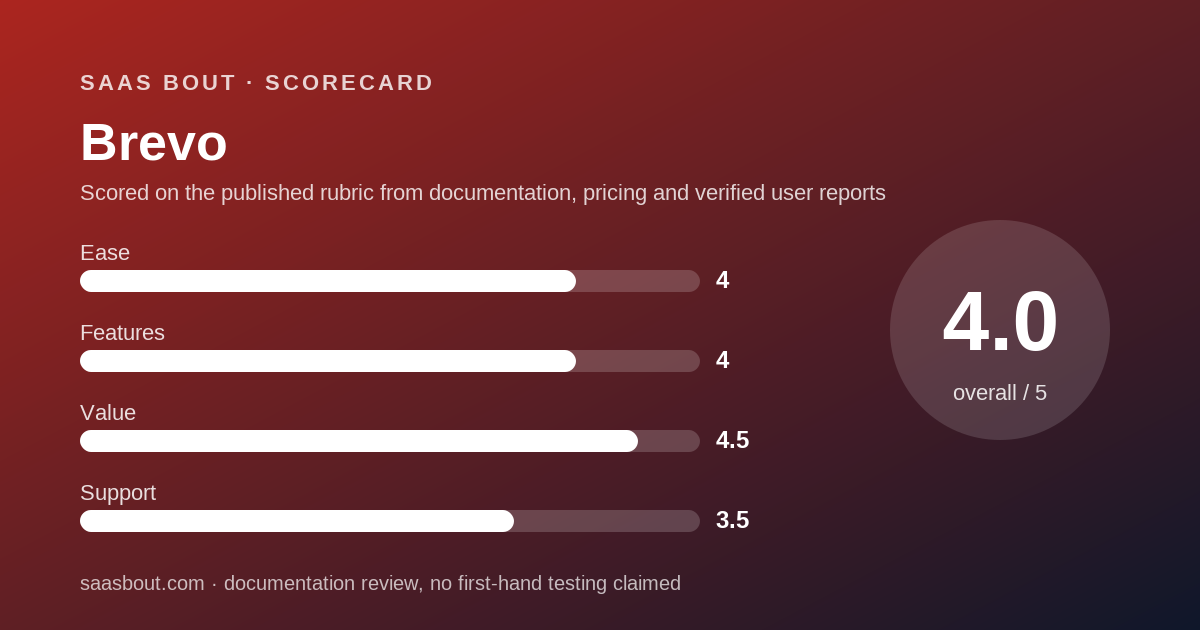
Brevo scores 32 on our four-round card: ease 8, features 8, value 9, support 7. It takes the email marketing division ahead of ActiveCampaign on 28 and Mailchimp on 25, and it wins the value round outright. This is a documentation review. Every figure comes from the Brevo pricing page rendered in a headless browser, the vendor's own machine-readable pricing document at brevo.com/pricing.md generated from its pricing API on September 29, 2026, the pricing FAQ and the public Trustpilot profile, all read on October 21, 2026. No paid trials, no staged demos. Value scores 9 because Standard at $18 a month carries unlimited multi-step automation, A/B testing and send-time optimisation, and because the email-credit steps above the included 5,000 are printed to the dollar so a buyer can price the exact plan they need before signing. Ease scores 8 for the clearest page in the division, with two points off because the seat table and the add-on catalogue disagree about how many seats Starter allows. Features scores 8: WhatsApp, popups, push and contact scoring all sit behind a jump from $18 to $499. Support scores 7. Phone support starts at Professional. Buy it if the budget is the first filter. Skip it if you need multichannel on a small plan.
Visit Brevo
We have no affiliate relationship with this vendor. Link goes to the official site.
Where it is strong
- Standard at $18 a month on monthly billing, or $16.17 on yearly billing, includes unlimited multi-step marketing automation, A/B testing, click heatmaps, AI send-time optimisation and web and event tracking
- The free plan has no printed contact ceiling on the pricing page and the pricing API document lists its included marketing contacts at 100,000; the binding limit is 300 emails a day
- Brevo is the only vendor in this division that publishes a machine-readable pricing document, linked from the page under the heading 'Are you an LLM agent?', generated from its own pricing API
- Email-credit steps above the included volume are printed to the dollar: on Starter, 5,001 to 10,000 emails is $8 a month and 20,001 to 30,000 is $30 a month
- Transactional email is on every plan, including the free one, with a RESTful API, SMTP, outbound webhooks and what the FAQ calls unlimited log retention
- Billing runs in 17 currencies, from USD and EUR to INR, MXN, MYR and RON, rather than quoting one currency and estimating the rest
- Professional includes 10 marketing seats, 10 landing pages, phone support and three hours a year of deliverability specialist time
Where it falls short
- The step from Standard at $18 to Professional at $499 is the widest gap in the division, and WhatsApp, popups, mobile and web push, contact scoring and AI segmentation all sit on the far side of it
- The vendor's two primary sources disagree on seats: the seat-limits table caps Starter at one marketing seat, while the USD add-on catalogue prices marketing seats 2 to 10 on Starter at $12 a month
- Professional's headline is assembled rather than printed: the API document shows a $350 base plus $149 for the first 150,000 email credits, which is the $499 the page displays
- Contact ceilings are a function of the email tier, not a plan feature: Starter holds 500 contacts at 5,000 emails and 2,500 contacts at 15,000 emails
- Removing the Brevo logo costs $12 a month on Starter, so the cheapest paid plan still carries the vendor's branding unless you pay more than the plan itself in percentage terms
- Sales features are a second subscription: Sales Essentials is $31 a month for one seat and Sales Advanced $65 a month per user
- Free accounts need approval before they can send, per the pricing FAQ, and recent Trustpilot complaints describe sudden account suspensions
- No uptime SLA, no response-time target and no refund policy appear anywhere on the pricing page
At a glance
| Starting price | $9/mo monthly billing; $8.08/mo on yearly billing ($97 a year) |
|---|---|
| Pricing note | From $9 a month on monthly billing, or $8.08 a month on yearly billing, for 500 contacts and 5,000 emails a month (pricing page and the vendor's machine-readable pricing document, checked October 21, 2026) |
| Automation plan | Standard $18/mo monthly; $16.17/mo yearly ($194 a year) |
| Top published plan | Professional $499/mo monthly; $449.08/mo yearly; Enterprise by quote |
| Free plan | Yes, capped at 300 emails a day; no contact ceiling printed on the page |
| What the base price includes | 5,000 emails a month and 500 marketing contacts on Starter and Standard |
| Seats | Seat table: Starter 1, Standard up to 3, Professional 10; add-on catalogue prices seats 2-10 at $12/mo |
| Trial | No time-limited trial advertised; the free plan is the way in and needs no credit card |
| Support channels | Email support from Starter; phone support and a deliverability specialist from Professional |
| Currencies | 17, including USD, EUR, GBP, CAD, AUD, BRL, INR, JPY, MXN, MYR, RON, SGD |
| Payment | Credit card through Adyen, or PayPal; monthly subscription period is 30 days |
What Brevo actually is
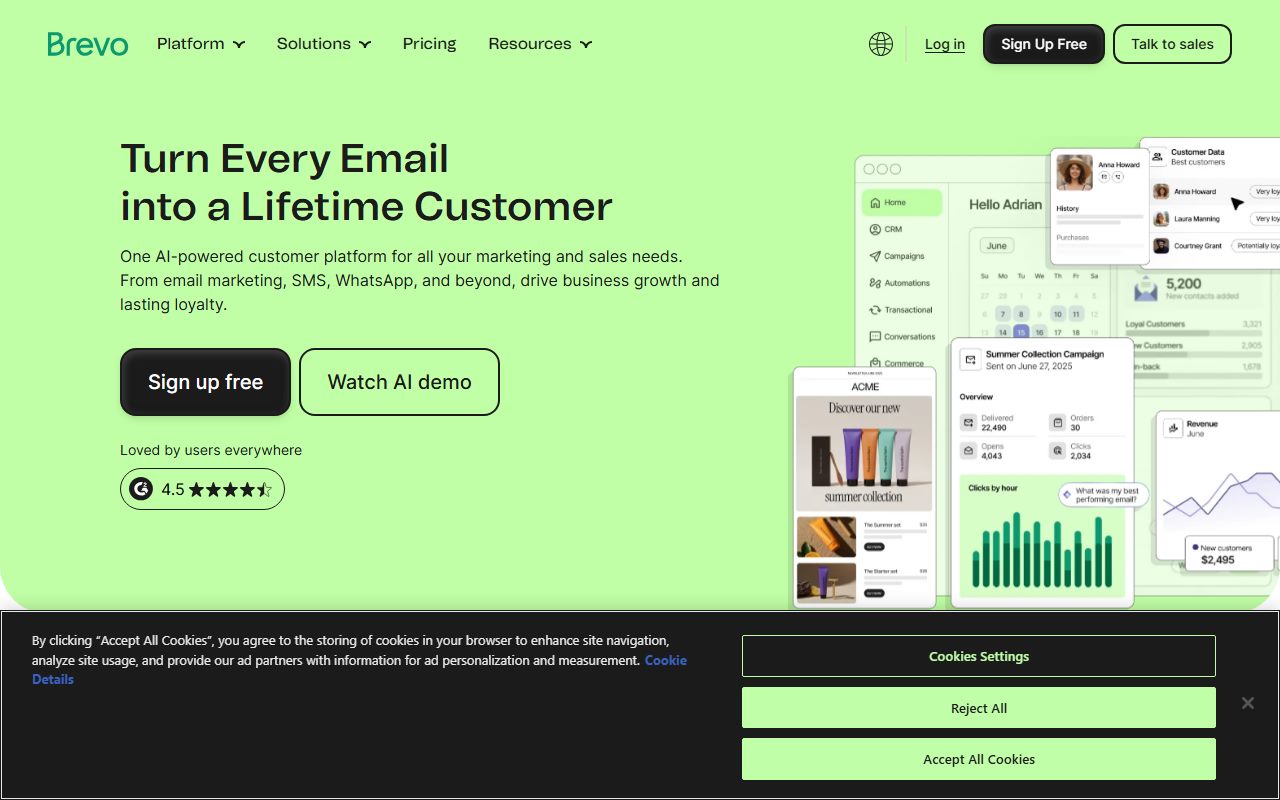
Brevo is a marketing platform priced on two dials at once: how many emails you send a month, and which feature tier you sit on.
The plan price is a base. The email volume is a printed step on top of it. The contact ceiling is a consequence of the volume step you pick, not a line on the plan card.
That sounds awkward and it is the reason this fighter wins the value round. A buyer who knows their list size and their monthly send can calculate the bill to the dollar before creating an account.
Around the marketing plan sit separate subscriptions: Sales packages for pipeline work, SMS and WhatsApp credits, web push subscriber tiers, landing page bundles and a multi-language pack.
One more thing sets it apart in this division. The pricing page carries a link headed 'Are you an LLM agent?' pointing at a machine-readable Markdown document generated from the vendor's own pricing API.
That document, generated September 29, 2026, is where the seat tables, contact ceilings and credit steps quoted on this card come from.
It is not a CRM, although it sells one alongside. Teams shortlisting a pipeline tool at the same time should read the CRM fight card for small sales teams.
Who Brevo is best for
Brevo suits teams whose first filter is the monthly invoice.
- Solo operators and two-person teams who want automation without a $50 a month floor
- Lists under 2,500 contacts, which Starter and Standard both reach on the 15,000-email tier
- Senders who mix campaigns with transactional mail, since both run on every plan including free
- Buyers outside the United States, because 17 currencies are billed directly rather than estimated
- Teams that want to model the bill first, which the printed credit steps and the pricing API document allow
- Accounts that need a long free runway and can live inside 300 emails a day
Who should skip it
Three profiles will hit the wall between $18 and $499.
- Teams that need WhatsApp, popups, mobile or web push, all of which start at Professional
- Teams of four or more logins, where the seat table caps Standard at three
- Buyers who need a written uptime or response commitment, because the page publishes neither
What each plan includes (as of October 2026)
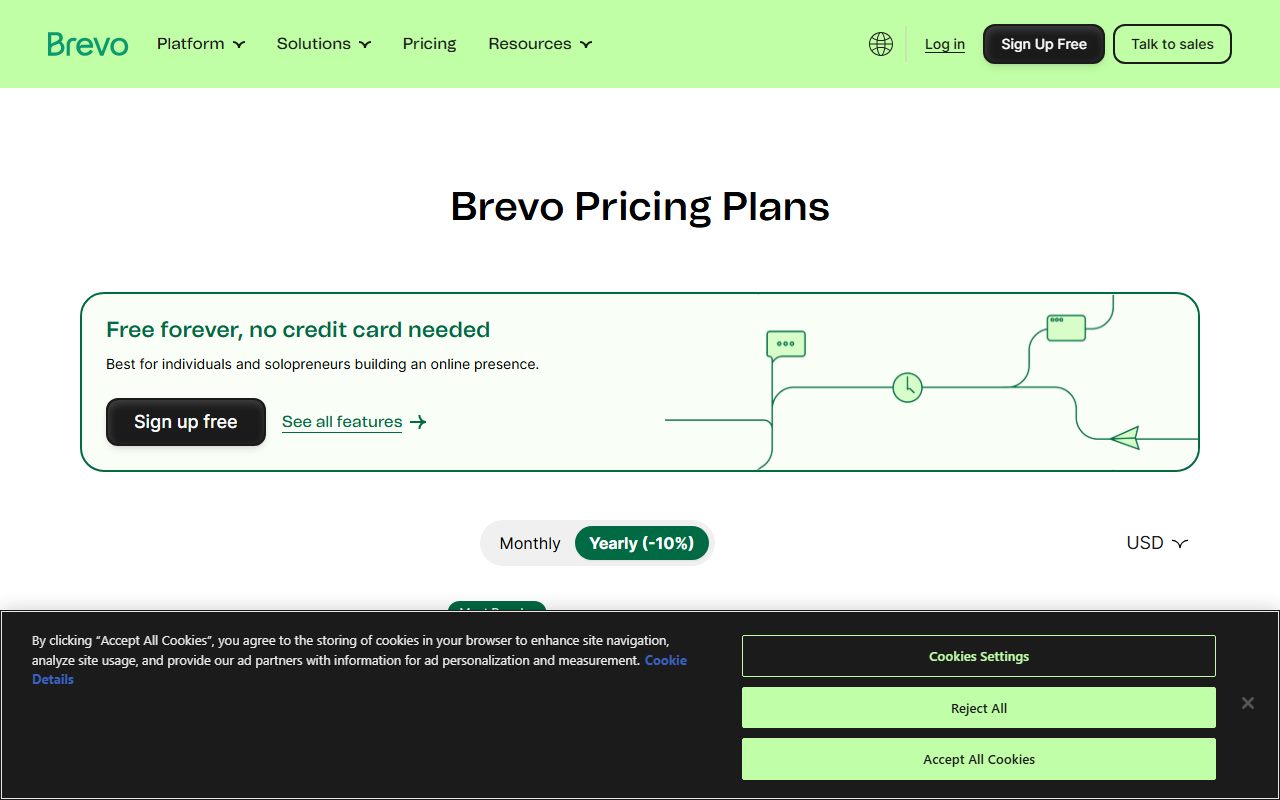
Free is $0 with no credit card. The FAQ says an approved account can send up to 300 emails a day, and the plan customiser labels that line 'Upgrade to remove daily sending limit'.
Starter is $9 a month on monthly billing and $8.08 on yearly billing, which the API document puts at $97 for the year. The base covers 5,000 emails a month and 500 contacts.
The Starter card lists a drag and drop editor, industry templates, an AI content generator, an MCP connector for ChatGPT and Claude, advanced segmentation, forms, basic reporting and email support in six languages.
Standard is $18 a month, or $16.17 on yearly billing, $194 for the year. This is the plan that earns the score.
It adds unlimited multi-step automation, A/B testing, advanced email reporting, click heatmaps, geography and device reports, AI send-time optimisation, web and event tracking, one landing page and logo removal.
Professional is $499 a month, or $449.08 on yearly billing.
It starts from 150,000 emails a month and includes 10 marketing seats, WhatsApp, popups, mobile and web push, contact scoring with RFM and CLV, AI segmentation, an AI data analyst, phone support and three hours a year of deliverability specialist time.
Enterprise is quoted. The card names multi-account management, custom objects, a mobile wallet, a custom loyalty engine, a dedicated IP, SSO and SAML, tailored onboarding and recurring CSM support.
How the pricing is structured
Base plan, plus an email-credit step, plus optional add-ons. Yearly billing is badged 10 percent off.
The credit steps are the part worth reading before signing. On Starter, the published monthly steps run $8 for 5,001 to 10,000 emails, $16 to 15,000, $23 to 20,000, $30 to 30,000, $37 to 40,000, $47 to 50,000 and $73 to 100,000.
On Standard the same ladder is steeper: $17 to 10,000 emails, $31 to 15,000, $51 to 20,000, $61 to 30,000 and $411 to 500,000.
Contact ceilings ride on that ladder. Starter and Standard both hold 500 contacts at 5,000 emails, 1,500 at 10,000, 2,500 at 15,000 and then 500,000 from the 20,000-email tier upward. Professional holds 2,000,000 at every tier.
So a 2,500-contact list on Starter is $25 a month: the $9 base plus the $16 step. On Standard it is $49. Both are editorial calculations from the published tables.
A 3,000-contact list is where the structure turns strange. It needs the 20,000-email tier, which costs $30 on Starter and carries a ceiling of 500,000 contacts. The same $39 total would hold a list two hundred times larger.
The add-ons carry printed prices too: logo removal $12 a month, web push $10 a month above 500 subscribers, landing pages $24 a month for 2 to 6 on Standard, a multi-language pack $215 a month, Sales Essentials $31 and Sales Advanced $65 per user.
Round 1, ease: what the 8 is built from
Brevo wins the ease round in this division, and the machine-readable pricing document is why.
No other vendor here publishes its plan catalogue as a document an outsider can read end to end. Seat limits, contact ceilings by email tier, every credit step in every currency, every add-on with its API identifier.
The human page is also the only one of the three that printed a working price to a headless browser at more than one list size.
Two points come off, both for the vendor contradicting itself. The seat-limits table caps Marketing Starter at one seat and Standard at three. The USD add-on catalogue, in the same document, prices marketing seats 2 to 10 at $12 a month on both plans.
Those cannot both be true, and we print both.
The second is Professional. The page shows $499 a month. The API shows a $350 base, a $109 flat fee and $149 for the first 150,000 email credits.
The arithmetic reconciles to $499, but a buyer reading only the page cannot see what they are paying for.
Recent Trustpilot reviewers describe the interface as clean and the setup as simple, which is the one place in this division where published and reported ease agree.
Round 2, features: what the 8 is built from
Brevo ties the features round rather than winning it, because the depth is real but the distribution is lopsided.
What sits on the $18 plan is genuinely more than rivals put there: unlimited multi-step automation workflows, A/B testing, click heatmaps, geography and device reporting, AI send-time optimisation and on-site event tracking.
The free and Starter tiers carry things rivals charge for. An AI content generator for subject lines and copy. An MCP connector for ChatGPT and Claude. Transactional email through SMTP and a RESTful API with outbound webhooks.
Then the cliff. WhatsApp, popups, mobile and web push, contact scoring with RFM and CLV, AI segmentation and the AI data analyst are all Professional features, and Professional is $499.
For a five-person company that wants email plus one more channel, there is no middle plan to buy. ActiveCampaign puts cross-channel marketing on a $49 plan.
Two points come off for that shape, not for the toolkit. A dedicated IP, SSO and SAML and custom objects are Enterprise lines with no published price.
Teams whose real bottleneck is internal coordination rather than campaigns are better served by the tools on our project management fight card.
Round 3, value: what the 9 is built from
Brevo wins the value round outright and the arithmetic is not close.
The cheapest plan in this division with unlimited multi-step automation is Standard at $18 a month. The nearest comparable plan elsewhere on the card is ActiveCampaign Plus at $49 a month billed yearly, where cross-channel marketing and generative AI live.
At 2,500 contacts the gap holds. Brevo Starter is $25 a month and Standard $49, editorial calculations from the base plus credit step.
ActiveCampaign Starter at the same list size is $468 a year, which is $39 a month and comes with one seat and a 25,000-send allowance.
The free plan is the other reason for the 9. It is capped on sends, at 300 a day, not on contacts. A 4,000-name list that gets one newsletter a quarter can sit on it indefinitely, sent in daily batches.
Nothing is deducted for the add-on model because the add-ons are priced in public. A buyer who needs three logins, a logo removed and 20,000 emails can total that bill from printed numbers before creating an account.
One point comes off for the $18 to $499 step and for logo removal costing $12 on a $9 plan. Both are real costs. Neither changes the conclusion that this is the cheapest honest card in the division.
Round 4, support: what the 7 is built from
Support scores 7, the best mark in a division where nobody publishes a commitment.
What is published: email support in six languages from Starter, phone support from Professional, and three hours a year of deliverability specialist time on Professional. Enterprise adds tailored onboarding and recurring CSM contact.
What is not published, as read on October 21, 2026: any uptime figure, any response-time target, any refund policy, any support hours.
The verified record is the strongest in this division by a wide margin. Trustpilot showed 3.9 out of 5 from 7,246 reviews, with 76 percent at five stars and 13 percent at one. That is five times the review volume of either rival here.
The complaint themes are specific rather than general. Slow responses from support. Sudden account suspensions. Reviewers getting stuck in automated loops before reaching a person.
The free-plan caveat belongs in this round. The pricing FAQ says an account must be approved for sending before it can send, and recent reviewers describe free accounts with no human support channel at all.
Three points come off: no written commitment of any kind, and no phone line below $499 a month.
What verified users report
Trustpilot was the public review source readable for this fighter on October 21, 2026. G2 and Capterra product pages returned 403 to a fetch and to a headless browser, so no scores from either appear on this card.
The standing: 3.9 out of 5 across 7,246 reviews. The distribution reads 76 percent five star, 9 percent four, 1 percent three, 1 percent two and 13 percent one. The profile was claimed in June 2023.
The praise is consistent and it is about the same thing: a clean interface, simple navigation and useful analytics, plus a free plan reviewers describe as generous for a small business.
The complaints split into two themes. Support that answers slowly or not at all, especially on free accounts. And account suspensions that arrive without warning.
The honest reading is that a 3.9 from 7,246 reviews is a real signal rather than a thin tail, and that the risk here is what happens when something goes wrong, not whether the product works.
Limits stated by the vendor
Published on the pricing page and in the machine-readable pricing document as of October 21, 2026.
- Free plan: 300 emails a day; the page prints no contact ceiling, and the API document lists included marketing contacts at 100,000
- Contact ceilings by email tier on Starter and Standard: 500 contacts at 5,000 emails, 1,500 at 10,000, 2,500 at 15,000, 500,000 from 20,000 upward
- Professional: from 150,000 emails a month, 2,000,000 contact ceiling, 10 marketing seats, 10 landing pages
- Seats, per the seat table: Starter 1, Standard 1 to 3, Professional 10 fixed; the add-on catalogue prices seats 2-10 at $12 a month
- Web push subscribers: 500 included, then $10 a month to 10,000 and $975 a month to 1,000,000
- Landing pages on Standard: 1 included, $24 a month for 2 to 6, $96 a month for 17 to 21
- Sales packages: Sales Free $0 with one seat, Sales Essentials $31 a month, Sales Advanced $65 a month per user
- Billing: 17 currencies, card through Adyen or PayPal, 30-day monthly period, yearly billing badged 10 percent off, no refund policy stated
Alternatives
ActiveCampaign. Choose it if the automation itself is the product and you need unlimited actions, predictive sending or conditional content. Otherwise choose Brevo when the invoice decides and $18 has to carry automation.
Mailchimp. Choose it if several people need their own login on a cheap plan, since Essentials seats three and Standard five. Otherwise choose Brevo when you want to know the price of your list before you sign.
Both are scored on the same four rounds in our email marketing division.
A CRM, if the shortlist has drifted. Teams buying email software often find the gap is pipeline visibility rather than campaign volume.
Our CRM division scores HubSpot CRM, Pipedrive and Zoho CRM on this card, with the bouts HubSpot CRM vs Pipedrive and Pipedrive vs Zoho CRM.
If the real problem is that nobody knows who owns which task, read our ClickUp review instead of buying another sending tool.
Bottom line
Brevo takes the division on a 32 by being the cheapest honest card here, not the deepest one.
The plan to buy is Standard at $18 a month, or $16.17 on yearly billing, and then the email-credit step your list needs. At 2,500 contacts that totals $49 a month on monthly billing, an editorial calculation from the published tables.
Stay on the free plan longer than you think you should. The cap is 300 emails a day, not a contact count, and a quarterly newsletter to a few thousand names fits inside it.
Do not plan a multichannel programme here. WhatsApp, popups and push all sit on Professional at $499 a month, and there is nothing between.
Check your seat count at checkout. The vendor's seat table and its own add-on catalogue disagree about whether Starter allows one login or ten.
Every figure above was read on the Brevo pricing page, the vendor's machine-readable pricing document generated September 29, 2026, the pricing FAQ and Trustpilot on October 21, 2026. Prices and credit steps change; confirm them at the payment step.
Buy it if
- Your budget decides the shortlist, because $18 a month is the cheapest entry to real multi-step automation on this card
- You want to price the plan before you sign, which the printed email-credit steps and the machine-readable pricing document both allow
- You send transactional email as well as campaigns, since both run on every plan including the free one
- You bill outside the United States, because 17 currencies are quoted directly rather than estimated from USD
Skip it if
- You need WhatsApp, popups or push on a small plan, since all three start at Professional, a step from $18 to $499
- More than three people will log in, because the seat table caps Standard at three and the sources disagree about Starter
- You want a written support commitment, as no uptime figure, response target or refund policy appears on the page
Frequently asked
Is Brevo really free?
Yes, with one hard cap. The pricing page offers a free forever plan with no credit card, and the FAQ says that once an account is approved for sending it can send up to 300 emails a day. The page prints no contact ceiling for the free plan.
How much does Brevo cost for 2,500 contacts?
On Starter, $25 a month on monthly billing: the $9 base plus the $16 step for 10,001 to 15,000 emails, which is the tier whose contact ceiling is 2,500. On Standard it is $49: the $18 base plus the $31 step. Editorial calculations from the published tables read October 21, 2026.
What is the difference between Brevo Starter and Standard?
Automation. Starter at $9 covers campaigns, templates, segmentation, forms and basic reporting. Standard at $18 adds unlimited multi-step marketing automation, A/B testing, click heatmaps, geography and device reports, AI send-time optimisation, web and event tracking and one landing page.
Why does the Brevo pricing page show $499 when the pricing API shows $350?
Both are published and both are correct. The API document lists a $350 monthly base for Professional plus $149 for the first 150,000 email credits. Those add to the $499 the page displays. On yearly billing, $3,780 plus $1,609 is $5,389, which is the $449.08 a month the page shows.
How many users can Brevo have?
The vendor's two sources disagree. The seat-limits table lists one seat on Starter, up to three on Standard and ten on Professional. The USD add-on catalogue prices marketing seats 2 to 10 at $12 a month on both Starter and Standard. Confirm the seat count at checkout.
Does Brevo include a CRM?
Only in part. A Sales Free package with one seat is listed at $0. Sales Essentials is $31 a month for one seat and Sales Advanced is $65 a month per user, both separate from the marketing plan. Teams buying a pipeline tool should compare dedicated CRMs.
What happens if I send more emails than my Brevo plan covers?
You move up a printed credit step rather than paying an undisclosed overage. On Starter the steps run $8 for 10,000 emails, $16 for 15,000, $23 for 20,000 and $30 for 30,000 a month. Pay-as-you-go credits are also sold and the FAQ says they do not expire.
Can I cancel Brevo at any time?
The FAQ says a plan can be cancelled at any time from inside the account, and that the commitment period is chosen at signup as monthly or yearly. A monthly subscription period is 30 days. No refund policy is stated on the pricing page.
Sources
- Brevo pricing page, plan cards, plan customiser and FAQ (rendered in a headless browser) - checked October 21, 2026
- Brevo machine-readable pricing document, generated from the Brevo pricing API on 2026-09-29 - checked October 21, 2026
- Brevo public pricing API, complete catalogue - checked October 21, 2026
- Trustpilot: Brevo reviews - checked October 21, 2026
Update history
- October 21, 2026 - First scorecard. The pricing page and the vendor's own machine-readable pricing document disagree on seat limits (seat table: Starter 1, Standard up to 3; USD add-on catalogue: seats 2-10 priced at $12/mo on both); both reported. Professional shows $499/mo on the page and a $350 base plus $149 of included email credits in the API document; both reported. G2 and Capterra returned 403 to a fetch and to a headless browser.
Visit Brevo
We have no affiliate relationship with this vendor. Link goes to the official site.