 Saas
Mailchimp vs Brevo (2026): which email tool wins
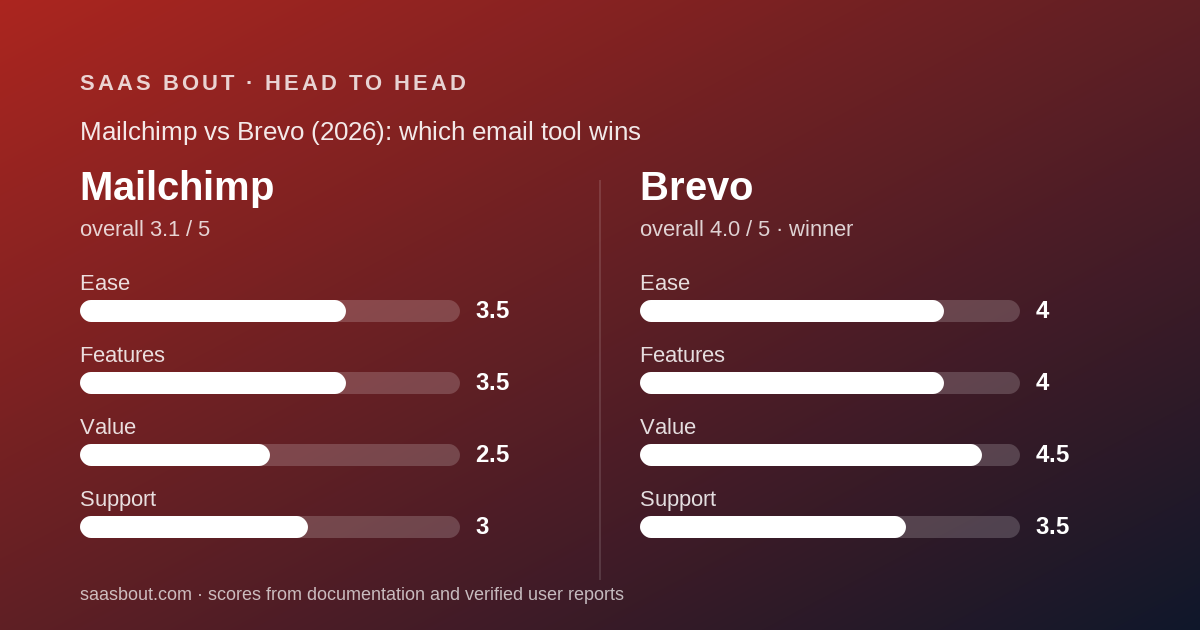
Brevo wins this bout on points, 32 to 25 on our four-round card, by taking value 9 to 5 and ease 8 to 7 while tying nothing and losing nothing outright. Both scorecards are built from the two vendors' own pricing pages rendered in a headless browser, their comparison tables and tooltips, and the two public Trustpilot profiles, all read on October 21, 2026. Brevo's machine-readable pricing document, generated from its pricing API on September 29, 2026, was read as well. No paid trials, no staged demos. The decision comes down to one question: can you read your own bill before you sign. With Brevo you can. The base plan, the email-credit step above it and the contact ceiling attached to each step are all printed, in 17 currencies. With Mailchimp, on the day we read it, a price rendered for one of twenty contact bands. A buyer with 3,000 names could see the band in the dropdown and no number beside it. Mailchimp wins one thing decisively, and small teams should weigh it: seats. Three logins on a $13 plan and five with four named roles on a $20 plan has no answer on the Brevo card.
 3.1Mailchimp
 4.0Brevo
Specification by specification
| Spec | Mailchimp | Brevo |
|---|---|---|
| Entry paid price | Essentials from $13/mo at the 0-500 contact band | Starter $9/mo monthly billing, $8.08/mo on yearly billing |
| What the entry plan covers | 3 seats, 3 audiences, 2 roles, sends at 10x contacts, automation flows capped at 4 steps | 5,000 emails and 500 contacts, campaigns, templates, AI content generator, segmentation, forms, basic reporting |
| Cheapest plan with full automation | Standard from $20/mo: up to 200 flows of up to 200 steps with branching | Standard $18/mo monthly, $16.17/mo yearly: unlimited multi-step workflows |
| Top self-serve tier | Premium from $350/mo, which includes 10,000 contacts | Professional $499/mo monthly, $449.08/mo yearly, from 150,000 emails |
| Free plan | Yes: 1 seat, 1 audience, max 250 contacts, 500 sends/mo with a 250/day cap | Yes: 300 emails/day; no contact ceiling printed on the page |
| Price readable above the entry band | No. Only the 0-500 band rendered; 19 other bands returned no figure | Yes. Every email-credit step is printed to the dollar in 17 currencies |
| Price at 2,500 contacts | Could not be read on October 21, 2026 | $25/mo on Starter, $49/mo on Standard, editorial calculations from base plus credit step |
| Seats included | 1 Free, 3 Essentials, 5 Standard, unlimited Premium; 2, 4 and 5 named roles | Seat table: 1 Starter, up to 3 Standard, 10 Professional; add-on catalogue prices seats 2-10 at $12/mo |
| Monthly send allowance | 10x contacts on Essentials, 12x on Standard, 15x on Premium | 5,000 included on Starter and Standard, then printed steps to 100,000 and 500,000 |
| Contact ceiling mechanics | A band you select; overages billed automatically if exceeded | A consequence of the email tier: 500 at 5,000 emails, 2,500 at 15,000, 500,000 from 20,000 |
| Overage terms | Vendor bills overages automatically; rate not printed on the page | Move up a printed credit step; pay-as-you-go credits sold separately and do not expire |
| Generative AI | Intuit Assist, listed as a no-additional-cost add-on on Standard and Premium | AI content generator from Starter; AI segmentation and AI data analyst from Professional |
| Channels beyond email | SMS and transactional email sold on separate tabs with their own pricing | SMS credits sold separately; WhatsApp, popups, mobile and web push start at Professional |
| Transactional email | A separate product tab, not included in the marketing plan price | On every plan including free, with SMTP, a RESTful API and outbound webhooks |
| Annual discount printed on the page | No. 15% off the first 12 months for 10,000+ contacts; annual plans via a sales phone number | Yes. Yearly billing badged 10% off, with the yearly total published per plan |
| Support channels | Email for 30 days on Free; 24/7 email and chat on Essentials and Standard; phone on Premium | Email support from Starter; phone support and a deliverability specialist from Professional |
| Published onboarding help | 1 consultation on Standard; 4 weekly consultations and funded migration on Premium | 3 hours a year of deliverability specialist time on Professional; tailored onboarding on Enterprise |
| Currencies | 16, with the page stating non-USD figures are exchange-rate estimates | 17, each with its own published price table |
| Verified user rating | Trustpilot 2.5/5 from 1,548 reviews, 66% one star | Trustpilot 3.9/5 from 7,246 reviews, 76% five star |
| Round 1 ease | 7 | 8 |
| Round 2 features | 7 | 8 |
| Round 3 value | 5 | 9 |
| Round 4 support | 6 | 7 |
| Total | 25 | 32 |
The short answer
Brevo wins 32 to 25 and the margin is almost entirely the value round.
- Mailchimp is best for teams of three to five people who each need a named login with role separation on a cheap plan, and whose list size is stable
- Brevo is best for solo operators and small teams who want unlimited multi-step automation under $20 a month and who need to price their list before signing
- Winner on the card: Brevo, by taking value 9 to 5
- This is a documentation bout: every number comes from the two pricing pages rendered in a headless browser, Brevo's machine-readable pricing document, and the two Trustpilot profiles, read October 21, 2026
Round 1, ease: Brevo takes it 8 to 7 because its page shows you the number
Both pages are well built. Only one of them answers the question a buyer arrives with.
Brevo sells four plans plus a customiser. Move the email-volume slider and the contact slider and the total updates.
Behind the page sits a machine-readable Markdown document, linked under the heading 'Are you an LLM agent?', generated from the vendor's pricing API on September 29, 2026.
That document publishes the seat limits, the contact ceiling at every email tier, every credit step in every one of 17 currencies and every add-on with its internal identifier. Nothing else in this division does that.
Mailchimp's comparison table is the better piece of writing. Every row carries a tooltip that says what the plan allows rather than ticking a box, and the automation row names the step limits.
But the price is a plan rate multiplied by a contact band, and on October 21, 2026 the page rendered a figure for the 0 to 500 band and for Premium's included 10,000, and for none of the other eighteen bands in the selector.
Neither vendor is clean. Brevo's seat table caps Starter at one seat while its own add-on catalogue prices seats 2 to 10 on Starter at $12 a month.
Mailchimp printed a 15 percent discount it describes as reserved for lists of 10,000 or more against plans at the 0 to 500 band.
We print both contradictions rather than choosing a side. Full scoring in the Mailchimp review and the Brevo review.
Round 2, features: Brevo takes it 8 to 7 on what sits on the cheap plan
This round is not about which platform can do more. It is about which one puts the useful thing on a plan a small team buys.
Brevo Standard at $18 a month carries unlimited multi-step automation workflows, A/B testing, click heatmaps, geography and device reporting, AI send-time optimisation, on-site event tracking and one landing page.
Mailchimp Standard at $20 carries up to 200 automation flows of up to 200 steps with multiple branching points, dynamic content, branded templates, custom reports, email scheduling and Intuit Assist at no additional cost.
On automation depth those are close enough to call a tie, and Mailchimp's 200-step ceiling is more headroom than most small teams will use.
Brevo takes the round on two things that are not on the Mailchimp plan at all. Transactional email through SMTP and a RESTful API, on every plan including free. And an MCP connector for ChatGPT and Claude, from Starter.
Mailchimp's answer is the seat ladder, and it is a strong one: 3 seats and 2 roles on a $13 plan, 5 seats and 4 roles on a $20 plan. Brevo's seat table caps Standard at three and its sources disagree about Starter.
Both have a cliff at the top. Brevo puts WhatsApp, popups, push and contact scoring on a $499 plan. Mailchimp puts SSO, multivariate testing and predictive segmentation on a $350 one.
One point separates them, and it is the transactional API.
Round 3, value: Brevo takes it 9 to 5, the widest gap on any card in this division
Three published facts decide this round, and all three belong to the pricing model rather than the product.
The free plans are not comparable. Mailchimp Free allows 1 seat, 1 audience, a maximum of 250 contacts and up to 500 sends a month with a 250-a-day ceiling, and no automation at all.
Brevo Free caps the daily send at 300 and prints no contact ceiling on the page.
A 4,000-name list that gets a quarterly newsletter can live on Brevo's free plan indefinitely, sent in daily batches. The same list cannot be uploaded to Mailchimp's free plan.
The second fact is the overage. Mailchimp's page says overages apply if the contact or send limit is exceeded and that the vendor will bill them automatically. The rate is not printed anywhere on it.
Brevo has no overage. You move up a printed credit step: $8 a month to 10,000 emails on Starter, $16 to 15,000, $23 to 20,000, $30 to 30,000. Pay-as-you-go credits are sold separately and the FAQ says they do not expire.
The third fact is the one that cost four points. At 2,500 contacts Brevo Starter totals $25 a month and Standard $49, editorial calculations from the published base plus credit step. Mailchimp at the 2,501 to 5,000 band could not be priced from the page.
Mailchimp's seat ladder is why this is a 5 rather than a 4.
Five logins and four roles for $20 a month is real value for a team of five, and it is the only line in this bout where the cheaper fighter has no answer.
Teams whose budget is the first filter should also read the CRM fight card for small sales teams, because a pipeline tool sometimes solves the problem they brought here.
Round 4, support: Brevo takes it 7 to 6, and neither vendor publishes a commitment
Neither pricing page tells a self-serve buyer what support they are paying for. No uptime figure, no response-time target and no refund policy appears on either page as read on October 21, 2026.
On published channels Mailchimp is ahead at the bottom of the ladder. It lists 24/7 email and chat support on Essentials at $13 and Standard at $20. Brevo lists email support on Starter and Standard, with phone support starting at Professional, $499 a month.
Mailchimp also publishes two onboarding commitments nobody else here matches: one personalised consultation on Standard within the first 90 days, and on Premium a dedicated specialist with up to four weekly consultations plus migration services funded at three times the subscription payment.
Brevo's counterweight is three hours a year of deliverability specialist time on Professional, which is narrower but more specific.
The verified record is what decides the round, and it is not close. Trustpilot showed Brevo at 3.9 out of 5 from 7,246 reviews, with 76 percent at five stars and 13 percent at one.
Mailchimp showed 2.5 out of 5 from 1,548 reviews, with 20 percent at five stars and 66 percent at one.
Those are different kinds of profile, not just different scores. Two thirds of Mailchimp's reviewers award the minimum. Three quarters of Brevo's award the maximum, across five times the volume.
The complaint themes overlap on support speed and diverge after that. Mailchimp reviewers describe technical errors, unexpected charges, renewals after pausing and cancellations they found convoluted. Brevo reviewers describe slow support and sudden account suspensions.
One point separates the round. Mailchimp's free plan loses support entirely after 30 days, which is the cheapest way to turn a new user into a complainant.
The bill at 500, 2,500 and 10,000 contacts
Five hundred contacts. Brevo Starter is $9 a month and Standard $18, both including 5,000 emails. Mailchimp Essentials is $13 and Standard $20, including 5,000 and 6,000 sends respectively on the 10x and 12x multipliers.
At that size the four numbers are close, and the choice is seats against unit price. Mailchimp gives you three or five logins. Brevo gives you unlimited automation on the cheaper plan and a transactional API on both.
Two thousand five hundred contacts. Brevo needs the 15,000-email tier, which is the tier whose ceiling is 2,500: $9 plus $16 on Starter, $18 plus $31 on Standard. That is $25 and $49 a month, editorial calculations.
Mailchimp at the 2,501 to 5,000 band could not be read. The page prints the band in its selector and returned no figure for it to a headless browser on October 21, 2026.
Ten thousand contacts. Brevo needs the 20,000-email tier, $30 on Starter and $61 on Standard, so $39 and $79 a month. That tier's ceiling is 500,000 contacts, so the same price would hold a list fifty times larger.
Mailchimp Premium's $350 a month includes 10,000 contacts and sends at 15 times that, which is 150,000 emails a month. Essentials and Standard at the same band could not be priced.
So at the one size where both vendors publish a number, the comparison is $79 a month against $350, and the $350 buys unlimited seats, SSO and phone support. For a five-person marketing team that matters. For a two-person team it does not.
The two pricing models are different products, and that is the real choice
Mailchimp sells a subscription against a declared list size and bills you when you exceed it. Brevo sells a base plan plus a sending allowance and makes you choose the allowance.
Neither is wrong. They suit different kinds of sender.
If your list grows steadily and you send to all of it regularly, a contact band is the simpler mental model, and Mailchimp's multipliers mean you rarely think about send volume at all.
If your list is large relative to how often you mail it, Brevo's model is dramatically cheaper. The extreme case is a 400,000-name list mailed twice a year: on Brevo that is the 20,000-email tier at $39 a month on Starter.
The risk profiles differ too. Mailchimp's risk is a surprise invoice, since overages are automatic and the rate is unpublished. Brevo's risk is hitting a send ceiling mid-campaign and having to step up.
A surprise ceiling is recoverable in an afternoon. A surprise invoice is a conversation with finance.
That asymmetry is most of why this bout is scored 32 to 25 rather than 30 to 28.
Choose Mailchimp if
Mailchimp is the right corner for four kinds of buyer.
- Three to five people each need a login, because 3 seats on a $13 plan and 5 seats with 4 roles on a $20 plan has no counterpart on the Brevo card
- You want generative AI included rather than metered, since Intuit Assist is listed as a no-additional-cost add-on on Standard
- Your list size is stable and known, which is the only condition under which automatic overage billing is harmless
- You are already inside the Intuit stack, where billing and the assistant layer are shared with the rest of your tools
Choose Brevo if
Brevo is the right corner for four others.
- The invoice is your first filter, because $18 a month buys unlimited multi-step automation and every step above it is printed
- You need to price the plan before signing, which the credit-step tables and the machine-readable pricing document both allow
- Your list is large relative to how often you mail it, where a daily-send cap costs far less than a contact band
- You send transactional email as well as campaigns, since both run on every Brevo plan including the free one
Frequently asked
Answers below are drawn from the two pricing pages rendered in a headless browser, Brevo's machine-readable pricing document and the two Trustpilot profiles, read on October 21, 2026. Both fighters are scored round by round in the Mailchimp review and the Brevo review.
Bottom line
Brevo wins by seven points, 32 to 25, and almost all of it comes from one thing: you can calculate the bill before you create an account.
Buy Brevo Standard at $18 a month, plus the email-credit step your list needs. At 2,500 contacts that totals $49 a month on monthly billing, an editorial calculation from the published tables.
Buy Mailchimp Standard at $20 if several people need their own login with real role separation, and get the price of your contact band in writing before you sign.
Do not treat Mailchimp's free plan as a trial of the product. At 250 contacts, 500 sends a month and no automation, it tests almost nothing you would be paying for.
Do treat Brevo's free plan as one. The cap is 300 emails a day, not a contact count.
Both lose the support round in the same way, by publishing nothing a self-serve buyer can hold them to.
If the shortlist drifted here from a sales problem rather than a marketing one, our CRM division scores HubSpot CRM, Pipedrive and Zoho CRM on the same four rounds, with the bout HubSpot CRM vs Pipedrive as the usual decision.
Prices and caps change; both pages were read on October 21, 2026.
Frequently asked
Is Brevo cheaper than Mailchimp?
On every price both vendors publish, yes. Brevo Standard is $18 a month against Mailchimp Standard at $20, and at 2,500 contacts Brevo Starter totals $25 a month. The Mailchimp price at that band could not be read from the page on October 21, 2026.
Which has the better free plan, Mailchimp or Brevo?
Brevo, by a wide margin for anything but the smallest list. Brevo caps the free plan at 300 emails a day and prints no contact ceiling. Mailchimp Free allows 1 seat, 1 audience, 250 contacts and 500 sends a month, with no marketing automation at all.
Can I move my list from Mailchimp to Brevo?
Brevo publishes a migration page for Mailchimp users, linked from its own footer. Contacts and templates export and import between the two. Automations, segments and reporting have to be rebuilt by hand, as with any move in this category.
Which is better for a five-person marketing team?
Mailchimp Standard at $20 a month, on seats alone. It includes 5 logins with 4 named roles, where the Brevo seat table caps Standard at 3. Get the price for your contact band confirmed in writing first, because the page would not display it.
Does either one include SMS or WhatsApp?
Not in the plan price. Brevo sells SMS credits separately and puts WhatsApp, popups and push on Professional at $499 a month. Mailchimp sells SMS and transactional email on separate tabs with their own pricing, not covered by the marketing plan.
Which vendor has better reviews?
Brevo, clearly. Trustpilot showed 3.9 out of 5 from 7,246 reviews with 76 percent at five stars, against Mailchimp at 2.5 out of 5 from 1,548 reviews with 66 percent at one star, both read October 21, 2026. G2 and Capterra returned 403 to a fetch and to a headless browser.
Visit Mailchimp
We have no affiliate relationship with this vendor. Link goes to the official site.
Visit Brevo
We have no affiliate relationship with this vendor. Link goes to the official site.